
Clarksville Previous Residents Era Map
A Clarksville address trail changes by era. The current property card is the practical entry point, but the Register's remote service does not publish an online start year. The Montgomery County Archives is the documented handoff for older deeds, probate, court, and Chancery material. Historic directories and census snapshots add time-specific address clues. Read the rows as a routing map, not as a claim that every source names every prior occupant.
| Source | Years it covers | Where held | What it shows |
|---|---|---|---|
| Assessor property card | Current portal; historic online start not stated | Spatialest / Assessor | Current parcel, owner and mailing fields, and transfer reference |
| Register deed index and images | Current subscription service; start year not stated | Register of Deeds | Grantor/grantee transfer chain and legal description |
| Archives deed books | 1788–1997 | Montgomery County Archives | Historic deed volumes when the web route is insufficient |
| Archives probate records | 1796–1990 | Montgomery County Archives | Estate and heir context for a transfer after death |
| County Court case papers | 1808–1989 | Montgomery County Archives | Older legal actions with named parties |
| Chancery minutes | 1840–2002 | Montgomery County Archives | Equity, real-property, and probate context |
| Clarksville directory leads | 1859–60, 1895, and selected 1911–1959 volumes | MCHS and directory catalogs; confirm local access | A period address or household clue, not ownership proof |
| Federal census | Released under the 72-year rule | National Archives and genealogy access points | Household composition at a decennial snapshot |
Start with the period that is known. A recent transfer calls for the parcel card and Register route. An older question may move directly to the Archives after the current parcel identifiers are captured. A directory or census match should be tied to its publication or census date before it is placed among Clarksville previous residents.
Clarksville Previous Residents Parcel Start
The Montgomery County Assessor's Spatialest card is the most efficient first record for previous residents of a Clarksville property. The Assessor reports 91,900 individual parcel-level property cards, so the card is a practical address bridge rather than a household list. Capture the property address, parcel ID, owner, mailing address, subdivision, lot, block, plat book/page, transfer date, instrument type, book/page, grantor, grantee, sale information, and sales reference. The card separates the property address from the owner's mailing fields. That separation matters: a tax mailing address can be elsewhere, and an owner field does not establish every person who used the property as an address.
Use the live Montgomery County property-card search to collect a stable parcel and transfer starting point.
The property card moves a Clarksville address into the identifiers needed for the deed chain. It is current parcel evidence, not an automatic history of each past household.
Clarksville Previous Residents Deed Chain
Once the parcel card supplies a transfer reference, the Register of Deeds provides the legal-transfer layer. Montgomery County uses a grantor/grantee index rather than an address index. The grantee is the party receiving an instrument, and the grantor is the party conveying it. For an older acquisition, the current seller is often the person to search as a grantee in an earlier instrument. Compare legal description, lot/block, subdivision, parcel reference, and derivation wording at every turn.
- Save the current parcel ID, legal or subdivision details, transfer date, book/page, and named parties from the Assessor card.
- Retrieve the identified deed through the Register's paid remote service, free public search-room computers, or a specific copy request.
- Match the deed's legal description to the parcel before treating it as part of the same Clarksville address trail.
- Use the prior seller as the next relevant party in the grantor/grantee index, then repeat the legal-description comparison.
- When the subscription route cannot supply the needed volume, move to the Register search room or the Archives deed books. Do not invent a handoff year because the county does not publish one.
- Grantor / grantee
- The grantor conveys an interest in a recorded instrument; the grantee receives it. Those labels identify a transfer role, not a current address.
- Chain of title
- A sequence of recorded transfers connected by the same legal property description. It is not a full title opinion.
- Legal description
- The lot, block, subdivision, parcel, or metes-and-bounds wording in a deed or plat. It can remain useful when a modern street label does not.
- Derivation
- Language or references that point back to an earlier source of title. It can help connect the next deed in the chain.
Review the Register of Deeds access directions before ordering a specific record.
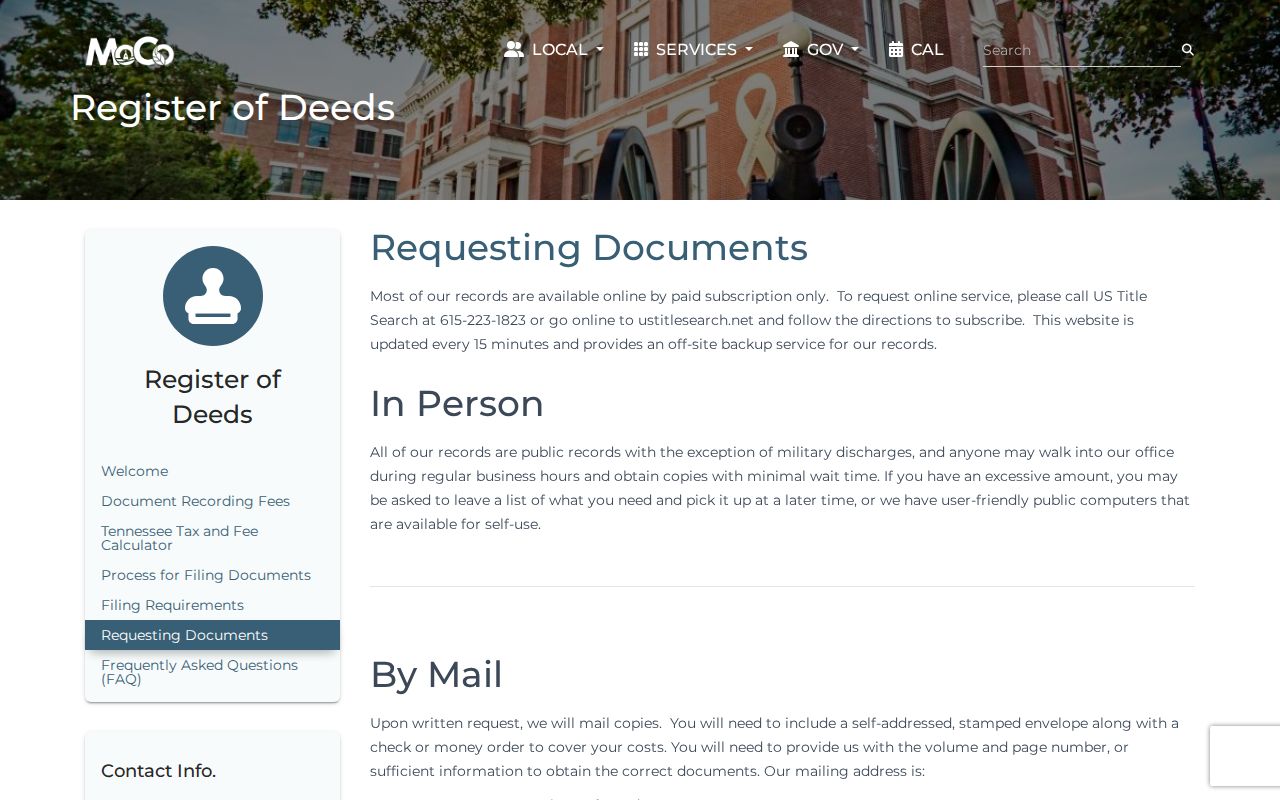
Paid off-site records, free search-room computers, counter copies, mail, and email are separate channels. Mail requests need a self-addressed stamped envelope, check or money order, and locating data; email copy requests need a contact name, phone number, and volume/page.
Clarksville Previous Residents Archives Route
The Archives gives a Clarksville property trail its deep-time route. Deed books reach 1788 and probate begins in 1796. County Court papers begin in 1808, while Chancery minutes begin in 1840. These are collection ranges, not a promise that every document within each range survived or is online. Still, they provide a documented next step when a transfer turns into an estate question or when a modern online search has no usable record.
Use the Montgomery County Archives collection page for the reading room, catalog, reference-library, microfilm, and digital-collection route.
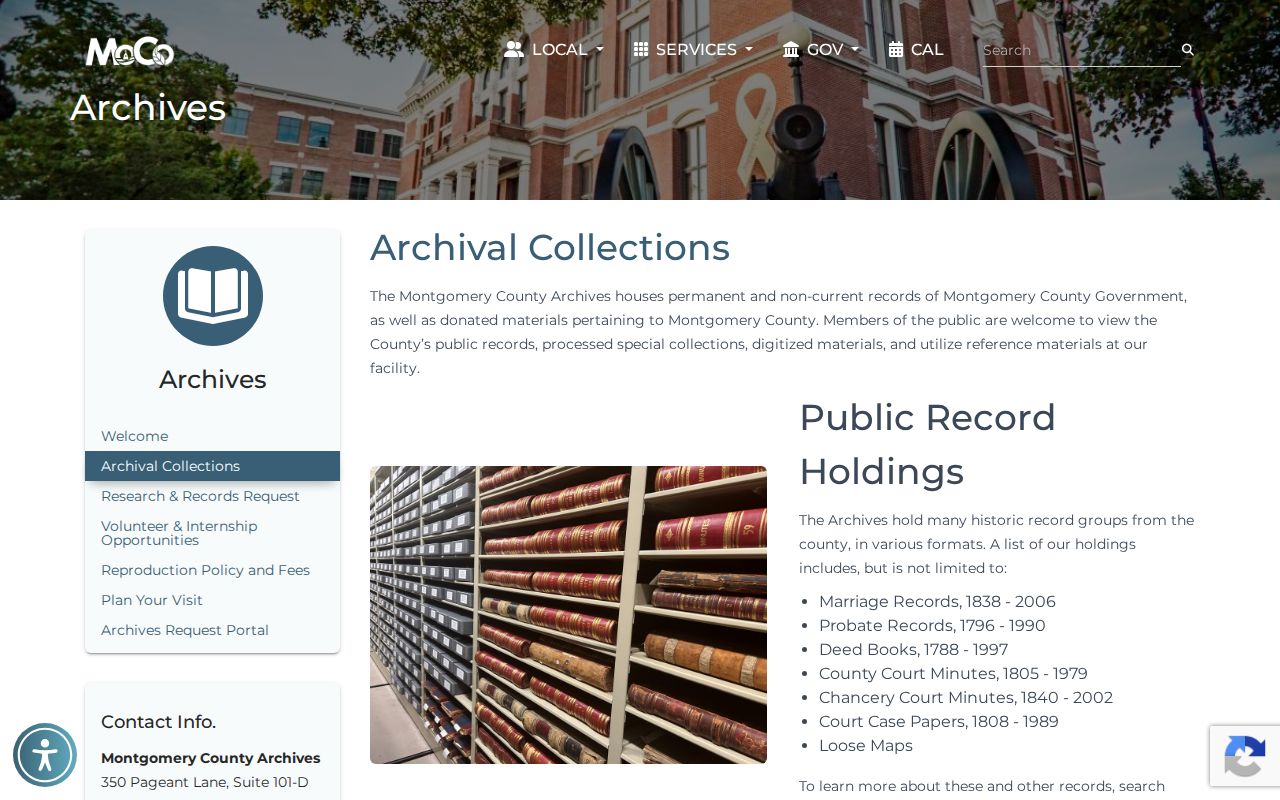
Visitors register annually with photo ID and should bring a surname, date range, and likely record type. The Archives asks visitors to use pencils or laptops rather than pens, a practical detail when gathering a Clarksville previous residents trail from original records.
The Montgomery County Archives digital collections provide another way to locate selected correspondence, photographs, pamphlets, scrapbooks, minute books, and yearbooks.
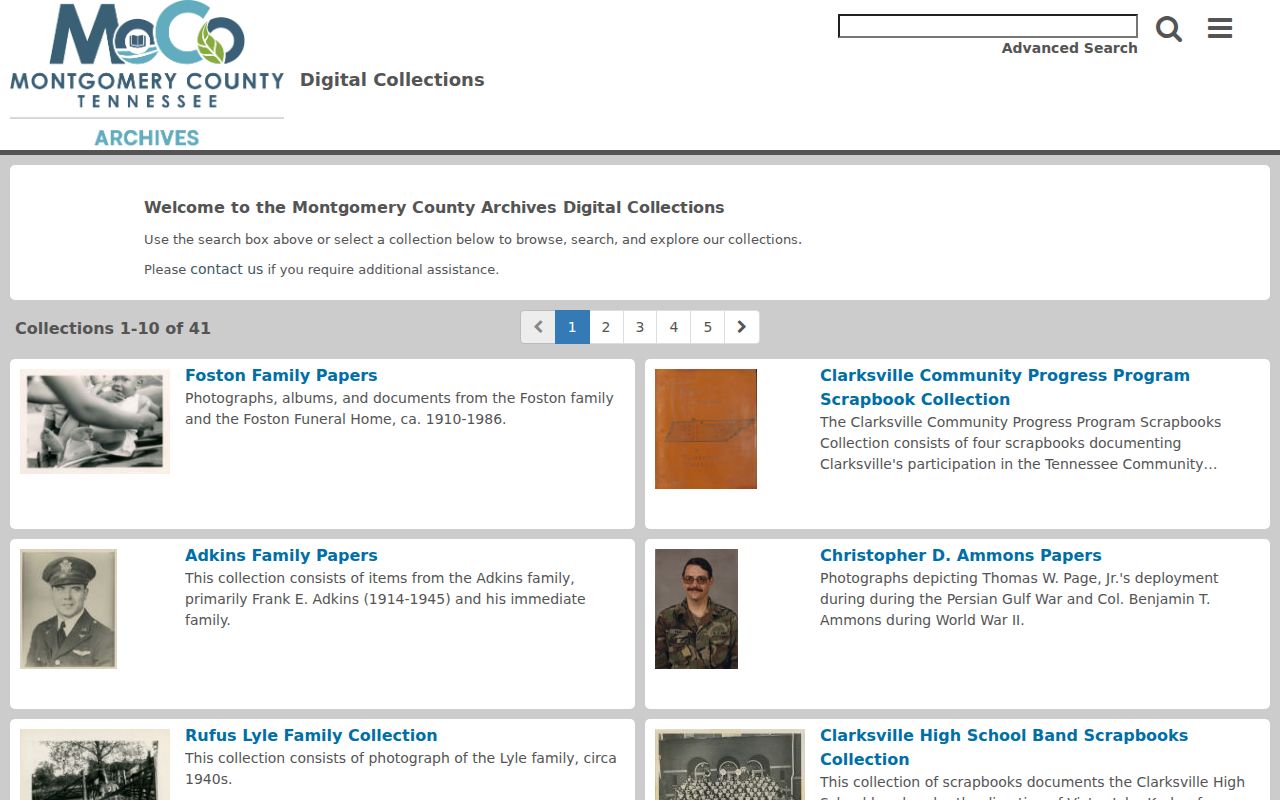
Digital materials can enrich a dated property story, but they do not replace a deed, probate file, or original directory when the question depends on a legal or address-specific record. The Archives' reproduction policy permits personal-reference photographs without flash and offers its request process, pickup or mail for ordinary copies, and digital delivery for digital materials. Copying can still be limited by condition, donor restriction, copyright, or law.
Clarksville Previous Residents Address Keys
A present-day street number may not be the best historic key. Parcels can be subdivided or combined, and older deeds may identify land by lot, block, subdivision, parent parcel, or other legal-description language. Record the modern address with the parcel ID and plat references, then follow the property description across the documents. The Regional Planning Commission controls current city/county addressing and maps, but no official source in the research verified a Clarksville-wide historic renumbering date. Do not assign one.
Sanborn fire-insurance maps can help check building footprints and street configuration, but the research did not verify a Clarksville year list. Ask the Brown Harvey, Sr. Genealogy Room or Archives what years and formats are available before placing a map in a Clarksville previous residents timeline. A recorded plat or deed remains stronger evidence for a legal property identity than a map image alone. For a dated construction clue, contact the proper city or county Building and Codes custodian by counter or phone, or make a focused public-record request for a permit number, application date, issue date, inspection or final date, work description, and address or parcel match. No public historic permit-search form was documented.
Note: Preserve a parcel ID, legal description, and deed book/page together when a historic street label is uncertain.
Clarksville Previous Residents Directory Clues
Historic directories add a different kind of evidence for Clarksville previous residents. Williams' Clarksville Directory, City Guide and Business Mirror is documented for 1859–1860. A 1895 Clarksville directory and selected U.S. city-directory volumes for 1911, 1922, 1929, 1942, 1947, 1950, 1952, 1955, 1957, and 1959 are documented collection leads. Microfilm existence has also been documented for several later spans, but an official current CMCPL shelf inventory was not located. Ask staff to check the exact volume or reel instead of assuming all years are on site.
The Clarksville-Montgomery County Public Library history page describes the Brown Harvey, Sr. Genealogy Room, built from county historian Ursula Beach's collection and supplied with books, microfilm, and digital databases.
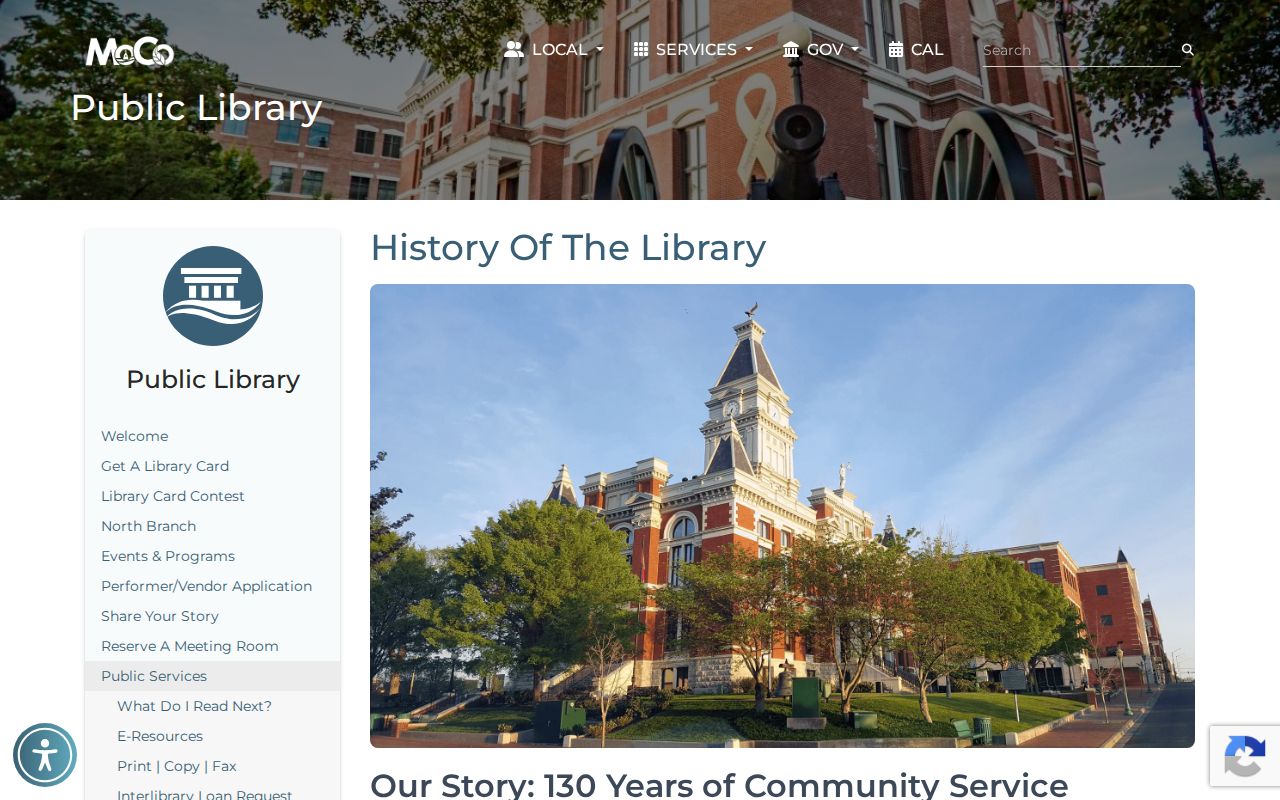
Give the librarian the address, surname variants, and date range. A reverse or criss-cross directory, if a relevant edition has one, can place a printed name at an address for that edition only.
The Montgomery County Historical Society history and genealogy resources identify the early Williams directory and a local obituary compilation.
The Historical Society is a named local source for directory and obituary questions. Confirm current reading, purchase, cemetery, or research-service access with the organization before planning a visit.
Clarksville Previous Residents Census Pairing
Pair a directory date with the nearest released federal census only after the address and name are plausible matches. Federal census records are historical snapshots under the 72-year release rule. A directory can fill the years between censuses, while a census can show a household composition not printed in a directory. Neither source turns an address hit into proof of ownership. The goal is a chain of dated clues that agree with the parcel, deed, and family context.
- Begin with the most recent confirmed name and Clarksville address from a property or recorded source.
- Request the closest documented directory volume or street section, then copy its exact printing and date.
- Compare an adjacent directory year for spelling variants, initials, widow descriptors, and address changes when an edition is available.
- Check the relevant released census snapshot for age, relatives, and household composition.
- Reconcile the match against deed, probate, and address facts. Stop when the legal description or family evidence diverges.
The documented directory collections are handled in more detail through the Clarksville city directory resource. For a backward address question, use each volume as a dated occupancy clue alongside, rather than in place of, the deed chain.
Clarksville Previous Residents Trail Endpoints
Probate and obituary material can close part of a Clarksville previous residents story when an owner dies or a record points to an estate. The Archives has probate records from 1796 to 1990. The Historical Society lists Richard and Bristol Gannaway's 11-volume Obituaries Compiled from Clarksville Newspapers, Montgomery County, Tennessee, 1810–1940. An obituary may identify relatives and a last-known place, but it needs confirmation against probate or vital material before it is used to connect an address.
Historic death records can enter the Tennessee State Library and Archives route after the state's 50-year public-access threshold. Earlier certified vital records have eligibility limits. For a local research request, ask whether the Archives, library, or Historical Society holds a cemetery, funeral-home, newspaper-clipping, or related collection for the surname and date. Donor restrictions, condition, copyright, or law can limit archival copying even when a catalog entry is public.
Clarksville Previous Residents Use Limits
Previous residents research is strongest when it is limited to property history, family history, estate questions, and local-history curiosity. An assessed owner is not necessarily an occupant. A directory line is a dated clue, not proof of a continuous connection. A census snapshot is historical, and a missing record is not proof that a person was absent. Keep these limits visible in every Clarksville address timeline.
Tennessee Safe at Home can provide an eligible participant a substitute address and does not permit a user to infer or bypass protected information. For an apparent record error, contact the custodian that holds the specific property, deed, archival, or vital record instead of treating a web result as final.